
Best IPTV USA 2026: The Complete Buyer’s Guide
How to pick the best IPTV service for live channels, sports, movies and high-quality streaming across your smart TVs and devices — plus an easy way to test it with a free trial.
Introduction
Television has changed dramatically in recent years. Many U.S. households are moving away from costly cable and satellite packages and toward internet-based streaming solutions that combine live channels, movies, sports and on-demand content in one place.
Internet Protocol Television (IPTV) is a fast-growing approach that delivers television over your broadband connection instead of traditional broadcast methods. With IPTV you can stream live TV channels, sports events, movies and TV series to smart TVs, streaming devices, computers and mobile devices — provided the service supports your devices.
Choosing the right iptv service can be confusing: providers differ in channel lineup, streaming quality, device compatibility, customer support and pricing. A service that fits one family’s needs may not suit another’s.
What you’ll learn in this guide:
- What internet protocol television (IPTV) is and how it works
- Which features matter most (streaming quality, channels, device support)
- How to test a provider with a free trial and the speeds you’ll need
- Practical tips to pick the best IPTV service for your household
A quick note for U.S. readers: the IPTV technology itself is legal. The legality of specific channels or content depends on whether a provider has the required licensing. Always verify that a provider is authorized to distribute the channels and on-demand movies or sports you plan to watch, and check any regional restrictions that may affect availability.
Ready to jump ahead? Use the Buyer’s Checklist to compare providers or start a free trial to test streaming quality and device compatibility yourself: Buyer’s Checklist · Start Free Trial
What Is IPTV?
IPTV stands for Internet Protocol Television — a method of delivering television over the internet rather than through traditional satellite or cable lines. Because IPTV uses internet protocol networks, providers can combine live channels, movies and on-demand content into a single service accessible on many devices.
Typical content available via iptv services includes live television channels, movies, TV series, sports, news, children’s programming, educational channels and international programming. Many providers also offer extras such as catch-up TV, cloud recording (DVR), electronic program guides (EPG) and personalized recommendations.
How IPTV Delivers Content — a simple flow
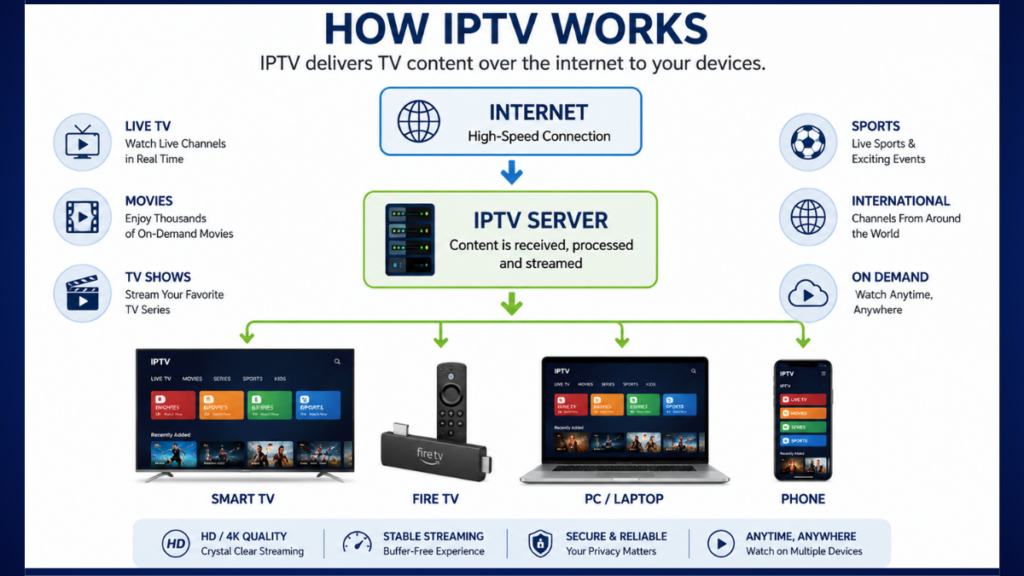
At a high level, the process looks like this:
- Broadcasters or content partners supply live feeds and on-demand files to the provider.
- The provider encodes and packages the content into streaming formats (adaptive bitrates, HLS/DASH, etc.).
- Streams are distributed from provider servers and CDNs (content delivery networks) over the internet.
- Users connect through an iptv-compatible app or media player on their device (smart TV, amazon fire, Android TV, phone, PC).
- The device plays the stream in real time; adaptive streaming adjusts bitrate to match your internet speed and network conditions.
Because IPTV uses the internet, the quality of the viewing experience depends on several factors:
- Internet speed — higher resolutions (Full HD, 4K) need more bandwidth; adaptive streaming helps but faster connections reduce buffering.
- Network stability — jitter and packet loss can cause pauses or quality drops even with good peak bandwidth.
- Device performance — older smart tvs or streaming sticks may struggle with 4K or complex apps; check device compatibility before subscribing.
- Home Wi‑Fi quality — signal strength and interference affect multi-device households; wired Ethernet gives the most stable results.
- Provider server capacity and CDN strategy — during big live events (popular sports channels or premieres), a provider’s infrastructure and CDN partners determine whether streams stay stable under heavy load.
A quick real-world example (best iptv usa)
If you’re watching a live sports channel during a major game, the provider must deliver many concurrent high-bitrate streams. A strong CDN setup and well-provisioned servers reduce latency and buffering; if capacity is limited, viewers may see dropped frames, long channel-loading times or reduced picture quality. Testing a provider during peak hours (via a free trial) is the best way to check real-world performance.
Tip: when evaluating providers, look for technical transparency (supported streaming protocols, CDN partners, and adaptive bitrate support) and easy ways to test channels on your devices. For device setup instructions, jump to the Installation Guide, and for legal details see the FAQ.
Why IPTV Has Become Popular in the USA
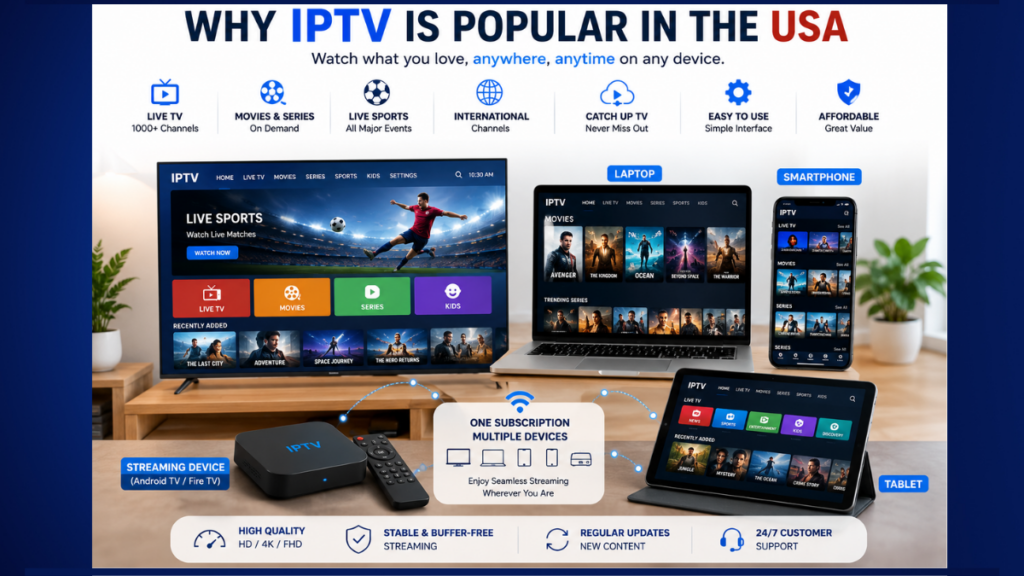
Several practical reasons explain IPTV’s rapid growth among American viewers. Modern iptv services combine live channels, streaming movies, sports coverage and on-demand content into one easy-to-use platform — often at a lower monthly cost than traditional cable or satellite.
Flexible viewing for modern lifestyles
IPTV lets you watch what you want, when you want. Many services combine live channels with catch-up and a large on-demand library, so families can switch between live sports channels, the latest movies and favorite TV series without juggling multiple apps.
Works on smart TVs and many devices
Most modern services support a wide range of devices, including smart tvs, Amazon Fire TV (amazon fire), Android TV and Google TV boxes, streaming sticks, Windows and Mac computers, plus Android and iOS phones and tablets. That cross-platform flexibility makes it easy to watch at home or on the go.
Large channel lineups and diverse content
Providers often offer extensive channel lineups — local and international channels, news, kids’ programming, lifestyle channels and dedicated sports channels — together with movies and on-demand content. This variety reduces the need to subscribe to multiple services.
Easier setup and lower hardware needs
Unlike satellite installations, many IPTV setups only require an internet connection and a compatible device or streaming box. That simplicity is appealing to users who want to avoid hardware and installation fees.
Fresh content and frequent updates
Good providers regularly update their channel lists, add new movies and refresh on-demand libraries to keep the service relevant for viewers who want the latest entertainment and live events.
Use-case examples
- Cord‑cutting family: replaces an expensive cable bundle with an IPTV plan that covers local channels, kids’ shows and a VOD movie library.
- Sports fan: subscribes to a provider with multiple sports channels and reliable high-quality streaming during live events.
- Frequent traveler: uses an account on multiple devices (phone, tablet, laptop) to watch channels and on-demand content while away from home.
If you prioritize watching sports or high-motion content, focus on providers with proven high-quality streaming and strong server/CDN infrastructure to avoid buffering during peak events.
Want to check device support or try channels on your smart tvs and devices right away? Jump to the Device Compatibility section or start a free trial to test real-world streaming and channels on your hardware.
Key Features to Look for Before Choosing an IPTV Service
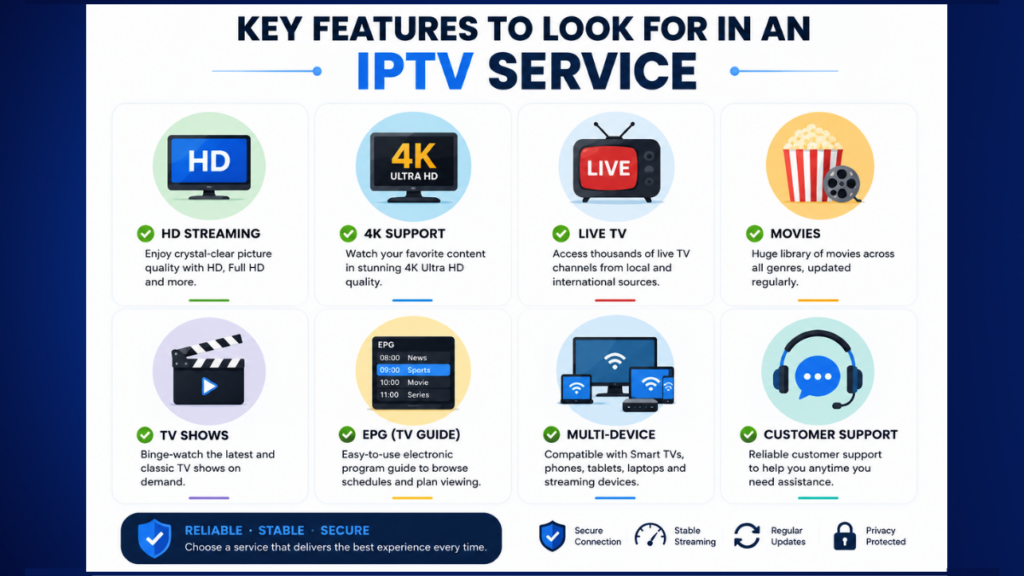
Not all iptv services deliver the same viewing experience. Before you subscribe, use this short checklist to compare streaming quality, reliability, device support and the practical features that matter to your household.
High streaming quality — why it matters
Streaming quality directly affects your viewing enjoyment. Look for providers that support HD and Full HD and, if you need it, 4K. Adaptive streaming (bitrate switching) is essential to keep playback smooth when internet speed fluctuates.
- Why it matters: Sharp picture and minimal buffering for live channels and sports.
- How to test: Use a free trial to stream the same channel in peak hours and check for buffering, picture drops or audio sync issues.
Try our 24-hour free trial to test high-quality streaming on your devices: Start Free Trial
Reliable server performance
A good provider keeps consistent uptime and fast channel loading, especially during major live events (sports, awards, premieres).
- Why it matters: Even excellent adaptive streaming can’t fix overloaded servers.
- How to test: Read recent user reviews and test during a busy time via a trial — watch a live sports channel to see real-world performance.
Device compatibility — check before subscribing
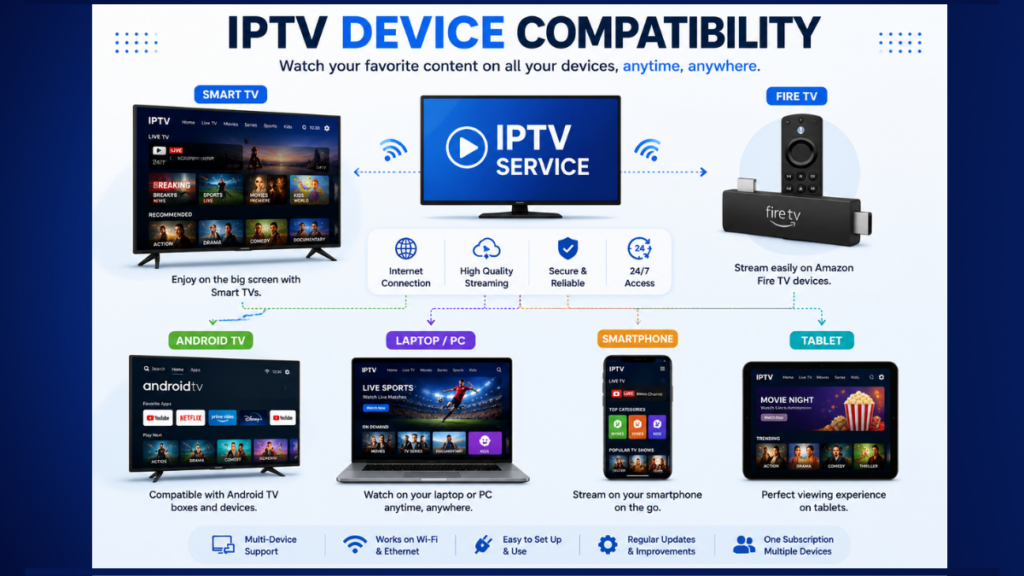
Confirm the provider supports the devices you use: smart tvs, amazon fire (Fire TV), Android TV, Google TV boxes, streaming sticks, Windows, macOS, Android and iOS. Also check whether third-party players (IPTV Smarters, TiviMate, VLC) are supported if you prefer them.
- Why it matters: Poor app support on your device can mean slow channel loading or missing features.
- How to test: Load the provider’s app or playlist on your smart TV or Fire TV during a trial and confirm channel loading times and remote navigation.
User-friendly interface & EPG
A clean interface, fast search and a solid electronic program guide (electronic program) make browsing channels and finding on-demand content much easier — especially for families.
- Why it matters: A disorganized channel lineup can waste time and frustrate users.
- How to test: During a trial, search for specific shows and navigate categories; check EPG accuracy and program descriptions.
Video-on-demand library
If you want movies and TV series alongside live channels, evaluate library size, update frequency and search functionality.
- Why it matters: A large, well-organized VOD (on-demand content) library reduces the need for extra subscriptions.
- How to test: Browse the VOD catalog during a trial and sample a few titles to check streaming quality and loading speed.
Multi-device & simultaneous streams
If your household uses several devices simultaneously, check how many concurrent streams the plan allows and whether each device type is supported.
- Why it matters: A single-view plan may block others from watching at the same time.
- How to test: Use the trial to run simultaneous streams on your devices and monitor quality on each.
Customer support & documentation
Responsive support (email, ticket, live chat) and clear setup guides or FAQs save time when you encounter issues.
- Why it matters: Troubleshooting help is crucial for less technical users.
- How to test: Contact support with a setup question before subscribing to test response time and quality.
Use these checks during a trial to evaluate streaming quality, device compatibility and the overall user experience. For a quick reference, jump to the Buyer’s Checklist.
Multi-Device Support
Households today use multiple devices — a living-room smart TV, a bedroom streaming stick, phones and tablets. A flexible iptv service should let you watch the channels and on-demand content you want across those devices.
- Typical device support: smart tvs, Amazon Fire TV (Fire TV), Android TV / Google TV, streaming boxes and sticks, Windows and Mac, Android and iOS phones and tablets.
- Simultaneous streams: plans commonly allow 1–4 concurrent streams; families should confirm the provider’s simultaneous-stream policy before subscribing.
- How to check: during a free trial, launch the service on two or more devices at once and watch for quality drops or blocked streams.
Customer Support
Responsive support matters when you need help with setup, account access, device compatibility or streaming issues. Good providers publish clear setup guides and offer multiple contact channels.
- Support channels to look for: email/ticket, live chat, phone (when available) and a searchable help center or FAQ.
- How to test: send a setup question to support during the trial and measure response time, clarity and helpfulness.
Trial Availability
Whenever possible, use a trial period to verify streaming quality, interface usability, content organization and device compatibility. Trials let you test channels and features on your exact devices before committing.
- What to test: stream a mix of live channels and on-demand movies, try channel zapping, test EPG accuracy, and confirm the number of simultaneous streams.
- Pro tip: test at different times (including peak hours) to see real-world performance under load.
Start a trial to run these checks yourself: Start Free Trial
Internet Speed Recommendations
Your internet connection is a key factor in streaming quality. These are general guidelines; actual needs depend on your network, number of simultaneous streams and whether the provider uses strong adaptive streaming.
| Streaming Quality Suggested Internet Speed What to expect | ||
| SD | 5 Mbps | Basic picture, suitable for phones and single small-screen viewing. |
| HD (720p / 1080i) | 10 Mbps | Good picture on most smart TVs; minimal buffering on stable connections. |
| Full HD (1080p) | 20 Mbps | Crisp picture for large TVs and reliable sports viewing (single stream). |
| 4K / Ultra HD | 35 Mbps or higher | High bandwidth for ultra-high resolution; multiple 4K streams will need proportionally more bandwidth. |
Keep in mind: if multiple devices stream simultaneously, add their required speeds together. For example, two Full HD streams may require ~40 Mbps total. For the most stable experience, prefer wired Ethernet when possible and place Wi‑Fi routers centrally to improve signal for smart TVs and devices.
Advantages of IPTV
IPTV combines live channels, on-demand movies and TV series into a single streaming experience, giving viewers more choice and flexibility than traditional cable or satellite in many cases.
Flexible viewing
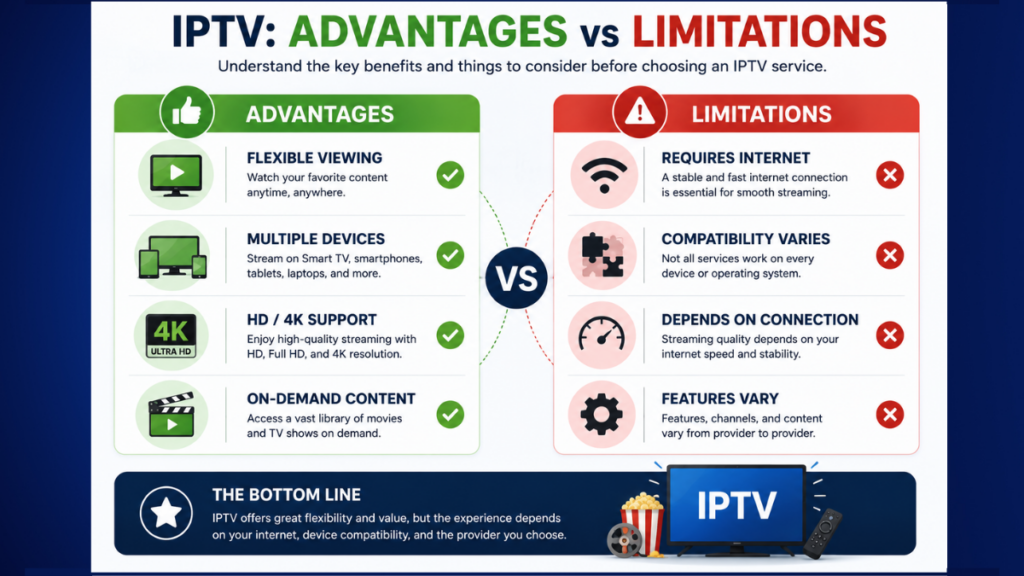
Watch live channels, catch-up TV and on-demand content across multiple devices. IPTV’s flexibility makes it easy to switch between live sports channels, the latest movies and family shows without juggling multiple subscriptions.
Large content selection
Many services offer broad channel lineups (local and international), extensive VOD libraries, sports channels and specialty content — reducing the need for additional streaming apps.
Convenient navigation
Good user interfaces, search, favorites and an electronic program guide (EPG) make finding channels and on-demand titles faster and more intuitive.
Limitations of IPTV
Despite its advantages, IPTV has limitations to consider before you switch.
Internet dependence
IPTV relies on your internet connection. Slow or unstable networks can cause buffering, reduced picture quality, or dropped streams — particularly during high-demand events.
Licensing and availability
Channel availability depends on provider licensing and regional restrictions. Make sure a provider legally offers the channels and programs you want in your area.
Common Mistakes to Avoid When Choosing an IPTV Service
Avoid these common pitfalls to get a better long-term experience.
Do / Don’t — quick checklist
- Don’t choose solely on price — the cheapest subscription can come with poor streaming quality and weak support.
- Do prioritize consistent streaming quality and reliable server performance over an inflated channel count.
- Don’t assume every provider supports your device — check device compatibility for smart tvs, Fire TV and Android TV first.
- Do use a free trial to test channels, on-demand content and simultaneous streams on your devices.
- Don’t ignore support — test customer support (email or live chat) during the trial to see how quickly issues are resolved.
Example of a poor choice
Buying a low-cost plan that advertises “1,500 channels” may seem enticing, but if the provider has unreliable servers and little or no support, you’ll spend more time troubleshooting than actually watching. Focus on provider transparency, uptime and real user reviews.
Key takeaways
- The best provider balances streaming quality, device support, customer support and valid channel licensing — not just channel count or low price.
- Use trials to test channels, sports streams and on-demand content on your actual devices during peak hours.
- Check refund, privacy and terms policies before committing to an annual subscription.
Ready to compare providers? Jump to our Buyer’s Checklist or start a free trial to test streaming quality and channels on your devices.
IPTV Buyer’s Checklist
Before choosing an IPTV service, take a few minutes to evaluate the points below. A careful, side-by-side check will help you avoid surprises and pick a provider that fits your viewing habits and devices.
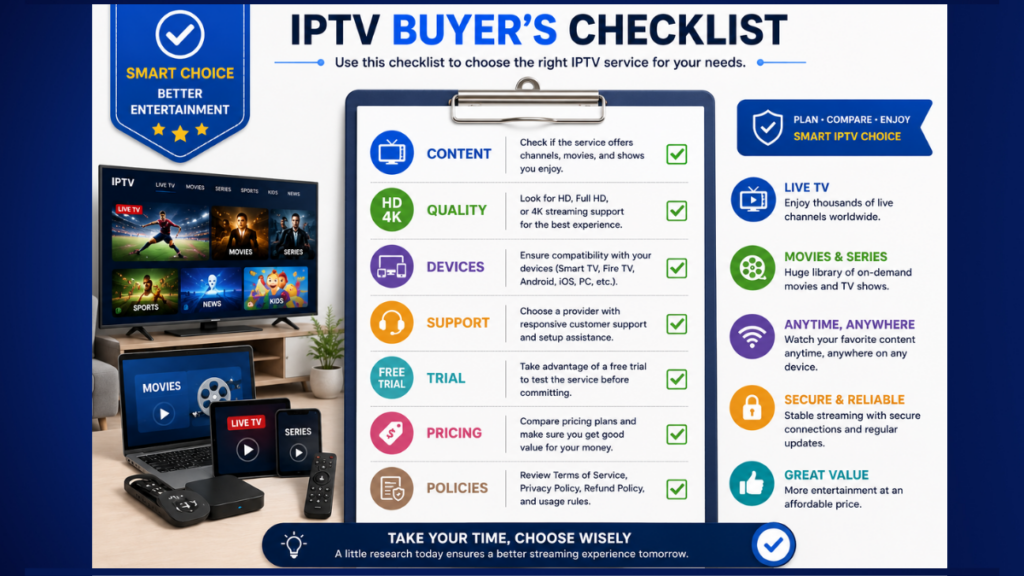
✔ Content selection
Choose a service that reliably provides the channels and on-demand content you actually watch:
- Local TV channels and accurate local channel lineup
- News networks and business channels
- Sports channels (verify live sports carry rights)
- Movies and TV series in the on-demand library
- Kids’ programming and educational content
- Documentaries and international channels
✔ Streaming quality & experience
Check that the provider offers the streaming quality you need and maintains a stable viewing experience:
- Supported resolutions: HD, Full HD, and 4K (if required)
- Adaptive streaming and low-latency delivery for sports and live channels
- Minimal buffering and fast channel zapping in real-world use
✔ Device compatibility
Confirm the service runs on your devices (smart tvs, Amazon Fire TV, Android TV, streaming boxes, Windows, macOS, Android and iOS):
- Native apps for your smart TV or a reliable web player
- Support for third-party IPTV players (IPTV Smarters, TiviMate) if you prefer them
- Clear instructions for setup on common devices
✔ Multi-device & simultaneous streams
Verify how many devices can stream at once and whether different device types are allowed simultaneously. Typical home plans permit 2–4 concurrent streams; adjust based on household needs.
✔ Electronic Program Guide & navigation
A usable electronic program (EPG) and fast search/save features improve browsing; test them during a trial for accuracy and convenience.
✔ Customer support & transparency
Look for clear contact channels (email, ticket, live chat), setup guides, and transparent policies for refunds, privacy and terms of service.
Tips for better IPTV streaming performance
Even the best iptv services depend on your network. These practical tips improve experience:
- Use a reliable broadband connection and check your internet speed before subscribing.
- Connect critical devices via Ethernet for the most stable streaming.
- Keep your streaming device firmware and apps updated to benefit from performance and security fixes.
- Restart your router occasionally and close background apps that consume bandwidth during streaming sessions.
- Position your Wi‑Fi router centrally and avoid heavy downloads while streaming, especially during live sports or premieres.
Frequently Asked Questions (FAQ)
- What is IPTV?
IPTV (Internet Protocol Television) delivers television over an internet connection instead of traditional cable or satellite. It can include live channels, movies, TV series and sports, often combined with on-demand content.
- Do I need a fast internet connection?
Yes. Required speeds depend on video quality and the number of simultaneous streams. For reference: SD ≈ 5 Mbps, HD ≈ 10 Mbps, Full HD ≈ 20 Mbps, 4K ≈ 35 Mbps or higher (see Internet Speed Recommendations). If multiple devices stream at once, combine their needs.
Final thoughts
IPTV changes how users access entertainment by combining channels and on-demand libraries into a single service you can use across devices. Whether you prioritize live sports channels, family entertainment or a large VOD catalog, pick a provider that balances streaming quality, device compatibility, customer support and transparent policies.
Next steps: compare providers using this checklist, test the ones that match your needs with a free trial, and validate performance on your actual devices during peak viewing times. Ready to try? Start Free Trial · Compare Top Providers